Featured

About this Blog

I suppose the purpose of this blog is no different than the purpose of any writing; i.e., to persuade, to inform, to entertain. (My English teacher would be thrilled to know I paid some attention in class!)

More specifically, after a varied and interesting 30 plus year career, I feel I have some things worth passing along; some things that I have learned about people and processes and systems. Further, I am most interested to hear your response to my posts!

So, let the sharing begin…


Subscribe below to receive notifications of new posts by email. Your contact information will not be shared with others without your permission.


11 Important Things When Planning ERP Projects

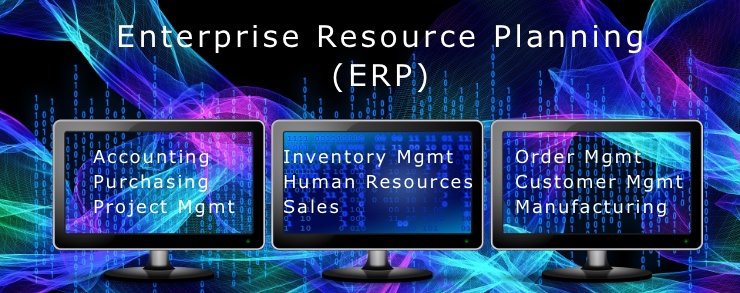
Enterprise Resource Planning (ERP) is an attempt to automate multiple organization functions (e.g., Accounting, Purchasing, Human Resources) with a single integrated software solution.  Having participated in a few ERP implementations, I’ve compiled a list of things you should know.

  1. Beware most implementations go over schedule and over budget.  Your ERP provider will argue this is your fault; i.e. you planned poorly or you permitted scope growth (and associated cost and schedule growth).  Your CFO will see it otherwise, as should you. 
  2. Freeze your baseline.  Pick a date when you will not permit further changes in requirements.  And stick with it.  See #1 if you don’t think this is important.
  3. Assign responsibility and authority to a single trusted and high level Project Manager.  No co-managers here. Ideally, not a career Accounting, Human Resources, or IT person.  Their functional bias will likely give you a suboptimal result.  See #7.  Instead, choose a Project Manager with a success record and who understands more than just one part of the organization. Then give them strong executive support.
  4. Communicate communicate communicate.  Keep management and affected employees informed of project status.  Ask for their participation throughout.  Sadly, no matter how often and well you communicate, someone on executive row will act as though this is all new, unexpected, and somehow technically unacceptable.  And they’ll conveniently wait to share these thoughts right before the Go Live Date.  Do not let this pause your implementation for even a minute.  CEO’s:  this speaks volumes about that executive… you know it…enough said.
  5. Be ready to change internal policies and procedures. Every ERP system assumes its software implements industry best practices and you should conform your practices accordingly.  Are you prepared to do this?  You’ll need new or revised policies and procedures. An ERP implementation is mostly a Change Management project with all the complexities of change management (e.g., obtaining internal buy-in, changing culture, introducing new tools and workflows, changing responsibilities, avoiding damage to the core business).  Of course, if you want to stick with your existing organizational processes, your ERP provider will help you… for a cost!  Significantly, this cost is not just the original implementation cost; each time the ERP provider updates its core software (i.e., the standard package sold to all clients), you will likely pay again to keep your customizations intact.
  6. Carefully select the data brought forward in your implementation.  Do you start fresh with only new data beginning on your Go Live Date?  There are some advantages (e.g. no need to clean, reformat, and import legacy data; no propagating historical errors).  Or, do you bring forward all active data?  If so, the filthiness of your existing data will shock you.  Cleaning historical data is a substantial chore. Huge decision.  Many organizations with more than a few years of history will do some of both.  That is, they will actually continue to maintain some legacy data on old systems at some minimum service level so they can have access to historical information.  What?!  Yes, you heard it here.  Dirty secret, but many organizations will decide to maintain their old systems for awhile after installing a new one.  If so, budget for it.
  7. Do not let one internal function dominate implementation at the expense of others.  Your ERP implementation objective is to successfully transition several functions, not just one.  Yet, we tend to assign ERP responsibility to one functional area, often Accounting or Human Resources.  The result may not be a great outcome; you might as well purchase a single function software package if you are willing to let a single function dominate implementation.  Often, ERP vendors reinforce a dominant single function approach in your organization.  This is natural as they generally begin as single function software providers, then add other functions as modules over time, often through acquisition   So, while today they sell you their integrated solution, you should recognize your provider’s functional roots,  such as Accounting (e.g., JD Edwards, SAP) or Human Resources (e.g., PeopleSoft, Workday), and guard against those roots dominating your implementation.  Here’s a clue:  ask how the Vendor came through your organization’s front door in the first place, if through Accounting, beware that Accounting does not dominate.
  8. Think through system reporting.  Your new ERP system will come packaged with standard reports to help run your organization.  Try to use these pre-packaged reports in lieu of custom reports.  To do so, you will need to carefully think through your Chart of Accounts to ensure you have the data fields necessary to pull your report.
  9. Do a robust trial run before the Go Live Date.  Prepare a Test Plan in advance to validate the trial data works.  Be especially careful with Payroll and Billing.  If you muff a live payroll or invoice cycle, you will seriously harm credibility with employees and customers.  These 2 areas are where failures show early and easily and to large audiences.  Manage the risk accordingly.
  10. Protect system security. Ensure responsibility is clear for both external and internal threats. Today, most ERP providers house your implementation in the cloud. And so, the ERP vendor should be able to demonstrate the security of your data from hackers on their site. Equally important is the attention necessary to control internal access. There should be a policy or procedure to reinforce this. Every user or every power user does not necessarily need to see into every corner of the organization. Think about payroll data as an example.
  11. Train users early. Make sure you adequately schedule, budget, and conduct training for users. Intensive training should occur before your Go Live Date. Best practice would also include a staffed Help Desk for users available on the Go Live Date and thereafter.

Like most things, there is no perfect ERP solution, only good enough.  You will need to balance many things, such as cost vs features, over- vs under-represented internal functions, your customizations vs the providers built-in “best practices”.  ERP solutions are a large investment that must serve the organization for a long time.  Good luck.


Subscribe below to receive notifications of new posts by email. Your contact information will not be shared with others without your permission.
Buzz Word Compliance

We know words can intimidate; but, this is especially so for words we don’t know. And that’s where the opportunity exists. It gives rise to an industry of people making a living using the latest terms we either don’t know, or terms we pretend to know to avoid seeming to be the ignorant person in the room.

Buzz Words have a foreign language thing going on

I credit the idea for this Post to an engineer colleague called Frank. We would often put together customer pitches, but before going to press, Frank would question whether we were ‘buzz word’ compliant. This meant using at least one buzz word for very 2 slides.

The ‘buzz word’ was some term that was sufficiently new, made up, or confusing as to be cool and trick cause others to believe we knew our stuff.

Guy Stevenson

Now, ‘stuff’ can never be a buzz word because it is simple and understandable on its face. But, here are some terms that breathe the rarified air of buzz:

  • Artificial Intelligence (AI) is the ability of a computer to think like an intelligent person. Can’t be done yet because computers don’t really learn. But that doesn’t stop marketers to advertise otherwise.
  • Blockchain is a system in which a record of transactions made in bitcoin or another cryptocurrency are maintained across several computers linked in a peer-to-peer network. Or, it’s a ‘computer log’.
  • Business Intelligence (BI) is the information a business collects about itself. ‘Company Data’ anyone? No, just not as clever sounding as Business Intelligence.
  • Metaverse is a hypothetical single, universal, and immersive virtual world focused on social connection, existing as a parallel to, or replacement of, the physical world through the use of personal computers, Augmented Reality (AR) headsets, and Virtual Reality (VR) headsets. Also known as the ‘end times’.
  • Scrum is a framework that helps teams work together. I think my mom invented this years ago when she sent me out to ‘play nice’.

I realize there is a level of snarkiness in this post. Maybe that’s because I have not invented the ideal buzz word yet. I’m working on it though. Have you heard about my new software category that sits over all other software? Thinking of calling it MetaEpi SupraSoftware (MESS).

Cheers!


Subscribe below to receive notifications of new posts by email. Your contact information will not be shared with others without your permission.

Best iPhone Hack

My friend who works at Apple taught me this nearly life-changing hack. I have always struggled to precisely position the cursor on my iPhone. So here is the fix:

If you click and hold the space bar, you can move the cursor almost like a mouse.

You’ll feel a haptic response, the cursor will pulse, and then, voilà, you can slide your finger on the space key as you would a mouse to navigate up, down, and diagonally.

This doesn’t seem to be advertised much, but it’s part of Apple’s 3D Touch. Apparently it’s been around since 2015 and works on iPhone 6 through iPhone X, excluding iPhone SE and iPhone XR. It also seems to work on my iPad which runs iPadOS 15.3.1.

Update: just got an iPhone 13 and this hack works on it as well!

Press and hold the space bar for easy navigation

Haptic Touch replaces 3D Touch on the newest iPhones.


Subscribe below to receive notifications of new posts by email. Your email contact information will not be shared with others without your permission.

Paperless, the 100% Solution?

Ah, the promise of the Paperless Office, replacing all paper with electronic files. I haven’t heard as much about it lately.

Personally, I think the Paperless Office is a useful goal, but perhaps at something less than 100%.

Guy Stevenson

There are many pros to digital documents:

  • Save time because there are no meaningful mailing or transit delays.
  • Store easier because they avoid the file cabinet farm, physical document handling, and document deterioration.
  • Share easier internally, with clients, and with others.
  • Can be edited and reformatted easier.
  • Avoid the cost of paper, ink, printers, copiers, and document storage.
  • Are better for the environment (although the paper industry has posted some interesting dissenting opinion about this, but that is a blog for another day)
  • Are more searchable (assuming you scanned it in editable text or you have a sophisticated image search capability).
  • Are more easily incorporated in to automated work flows.
  • Better support field work, going mobile, and the work-at-home trend.
  • Reduce paper clutter which presents a more professional and efficient work environment.

Likewise, there are many pros to using paper documents:

  • Are easier on the eyes and mind than documents on screens. For me, this is especially true for long documents. I can readily make margin notes, highlight text, flip back and forth, and suffer less eye fatigue than with digital documents.
  • Do not require power, computing devices, networks, or connectivity.
  • Do not present the normal computer distractions (e.g., social media interruptions, pop-ups, visual and audible notifications, texts, spam, malicious software)
  • Avoid the initial and recurring costs of digital documents. Scanning, tagging, and organizing legacy and current documents in to folders takes time and effort. Networks require set up, connectivity, training, maintenance, and IT skills.
  • Readily support transactions that still require an actual signature.
  • Provide the weight of paper; that is, some documents just seem nicer to us in paper form (e.g., thank you notes, invitations, birthday cards, diplomas, journals).
  • Provide better support for some large format documents (e.g., architectural drawings, construction drawings, posters, maps, newspapers)
  • Provide better support for some small format documents (e.g., claim checks, raffle tickets, garage parking tickets, id cards, receipts).
  • Avoid cyber attacks and the associated cost of constant monitoring and updating of hardware and software.
  • Avoid those elusive savings questions. No one seems to pass the lower costs of digital to consumers. Music is the big example. The cost of the physical media itself (e.g., vinyl records, album covers, tapes, CDs) and its transportation costs have gone down, down, down to almost nothing (e.g., .mp3, .wav files). But the price of an album of music has not. Someone, other than the consumer, has pocketed all the savings.
  • Provide a pathway to eventual automation. Those paper documents, what I call “forms” embed many things (e.g., work instructions, work processes, work packages, job aids, procedures, policies, best practices, internal controls, corporate governance) that you may ultimately desire to automate.

Forms, a Special Case

That last bullet caused me to rethink my website menu and so, I have added a Tools menu item to include forms that you might find helpful on this eventual path to automation.

I didn’t include a Tools menu previously because I didn’t want to deal with the inevitable criticism of being a Luddite, stuck in the old ways.

Yes, these forms presume paper printouts or a semi-digital process.

By semi-digital I mean that fat area of the pie chart in which documents aren’t paper, but they aren’t full-on digital. We don’t talk much about this area, but it looms. You know the processes: (1) “File Open / Print / Fill In by Hand / Scan / Save / Send Electronically or the more sophisticated (2) “File Open / Fill in by Keyboard / Save / Send Electronically”.

Of course, forms should ideally be in digital format, start to finish and in between.

Guy Stevenson

But not everyone is there yet, especially small businesses. I imagine even the most automated firms still have some paper forms lurking about.

Having paper forms is not necessarily effort lost to some prehistoric time because the “blanks” on your form become the “fields” in your future automated system design. You shouldn’t have to think so hard about system design if you already have processes supported by good forms. Just review and validate your forms, right? It may not be that simple, but it’s not that complicated either.

In Conclusion

So back to the beginning, I’ll probably not see 100% paperless in my lifetime. I’m ok with that, not that anyone asked my opinion.

Until then, a more reasonable goal might be 50% paperless. And that’s in the total organization. Some areas, such as production, lend themselves to something approaching 80% paperless because we tend to invest in automated systems in areas that make our money.

Cheers!


Subscribe below to receive notifications of new posts by email. Your contact information will not be shared with others without your permission.

The Fundamental Thing Omitted

The monitor display on my computer suffered from overscan. That is, the image on the display was slightly larger than the screen. The edges of the picture were lost. Consequently, I could not see the menu bar. No problem, I’m tech savvy. I can figure this out.

An hour later…

After consulting various support sites and fiddling with the display settings on my computer without result, I messaged a support forum and received this response:

“You need to make the adjustments on the monitor itself, not on your computer [you idiot]”

Ok, I added the “you idiot”. And I felt like an idiot. I had spent an hour under the hood of my computer, instead of a minute on my monitor. In my defense, no one said the adjustment was to the monitor, not the computer.

Everyone assumed I knew this and in the process, everyone omitted the fundamental thing.

With no particular back up, I believe such omissions happen all the time. Perhaps, with great consequence. I’m sure politicians do it daily, and on purpose, but I’m not talking about professional liars. I’m speaking of people genuinely trying to be helpful and falling short because they have left out some fundamental thing. Context is key.

In school, I could rely on the kid in the front row to ask the stupid question that I was afraid to ask for fear of revealing my own stupidity. That kid seemed to always ask the question that put things in context so they made sense. I have come to appreciate that kid’s fearlessness later in life. Alas, I’m not in school anymore. I just need to be more fearless and ask the question so we all know what’s really going on.

What do you think? Care to share a similar event?


Subscribe below to receive notifications of new posts by email. Your contact information will not be shared with others without your permission.

Flavor of the Day Management

Years ago, I worked for a company president who recently read the latest management book. It was about Participatory Management. That’s where employees at all levels participate in decision-making. To be sure, engaging employees in their work is commendable. But this went to an extreme.

Flavor of the Day management will confuse and frustrate

First, with the stroke of his pen, the president did away with all company policies & procedures with the thought that workplace guidance, by definition, was an unreasonable and unneeded burden for employees. The Human Resources VP and the Legal VP almost lost their minds… there are lots of legal and regulatory compliance matters that require you have written policies & procedures. Further this mandated guidance is typically a large part of business systems (such as IT Systems, Purchasing Systems, Accounting Systems, Engineering Systems, Manufacturing Systems, Property Systems, Security Systems) that larger and more sophisticated clients want to know exist and are effective.

Despite the contrary rhetoric, folks do want to be told what to do (i.e., given guidance) at some level and in a respectful way. Especially so with larger groups which require some fundamental level of guidance to prevent confusion, provide organization, ensure legal compliance, etc.

After a few days of aggressive client and employee pushback, the president relented and allowed that the company, with its thousands of employees scattered across the globe, could exist with 10 one-page policy statements. I have no idea why 10. Of course, this vacuum of guidance detail led to confusion ad nauseam. From “how do I get travel reimbursement?” to “how do I get evaluated and promoted?” You can imagine the fallout. Typically, the work around was to send out the previously outlawed guidance… too funny.

Second, he empowered employees with unlimited decision-making authority within their respective workgroups. This was my favorite. Within a week, employee workgroups met to “vote” fellow members “off the team”. No legal compliance check, no discrimination testing, no due process, no anything… just a note saying you’re off the team, good luck.

I’ve seen this repeated throughout my career. Excessive management enthusiasm for something that probably has some merit, but definitely has some weaknesses. Remember these??

  • Management by Walking Around (more engaged management, but hard to implement with today’s dispersed workers, especially with the COVID home offices)
  • Total Quality Management (task standardization over creativity?)
  • One Minute Management (catching people doing things right is nice, but one minute critiquing and praising? am i paper training human beings?)
  • Flat Organizations (limits to span of control?)
  • Matrix Management (where authority is uncertain, does it exist?)
  • International Standards Organization (ISO)(more about documentation than actual results)
  • Lean Manufacturing (Just in Time inventory in the recent age of Supply Chain failure? How did that work for you?)
  • 360-Degree Feedback (evaluated by inexperienced raters and by peers I compete with for promotion? Sign me up.)

Please do not misunderstand me. I’m not saying these are all bad. In fact, most have more benefits than criticisms. What I am saying is this:

I don’t recommend you define your business based on the latest trend. Your business is more complex than that and the enthusiasm for the trend will pass. Instead, consider the many time-tested solutions that we know work.

Guy Stevenson

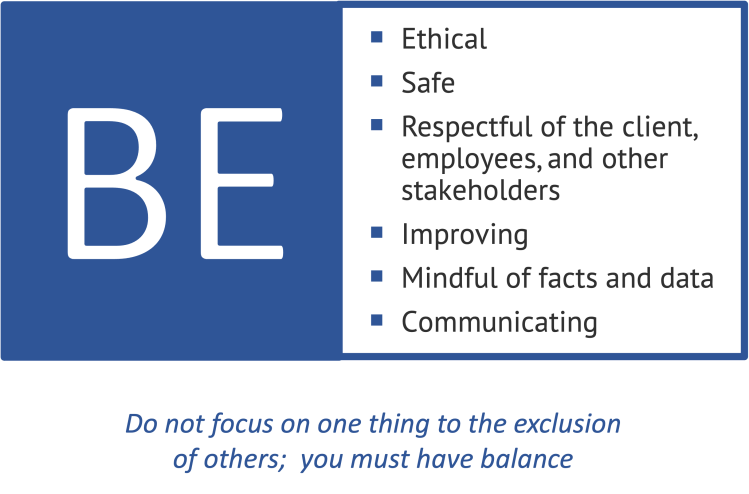
Yes, today’s manager has to pay attention to multiple things at a time. One cannot just overreact and focus on one thing (such as quality, or safety, or the customer, or the employee) to the exclusion of others. You must have balance. And there is not much new under the sun regarding what those balanced items might be.

Balance many things rather than overemphasize one

This is my list of proven and balanced focus areas at a high level. You probably have something similar:

    Nothing new or brilliant here. Most all trends will incorporate one or more of these really well and in depth, but are not robust enough to cover them all. And all must be meaningfully addressed.

    Cheers!


    Subscribe below to receive notifications of new posts by email. Your contact information will not be shared with others without your permission.

    Inspiring Quotes

    I’ve collected some quotes over the years that I want to share. I must first say that because I have quoted someone, it does not mean I approve of everything they may have said or done. I’m sure some here are anarchists, socialists, and radicals of different sorts. That doesn’t mean they never had anything interesting to say.

    Also, I realize that quotes are often misattributed. Kindly let me know if you see any such errors so that I may correct them.


    “The only thing worse than being blind is having sight but no vision”
    Helen Keller

    “The world is moving so fast these days that the man who says it can’t be done is generally interrupted by someone doing it”
    Elbert Hubbard

    “Eighty percent of success is showing up”
    Woody Allen

    “It’s not what you don’t know that hurts you, it’s what you know with absolute certainty, that really isn’t so”
    Mark Twain

    “When angry, count ten, before you speak; if very angry, a hundred”
    Thomas Jefferson

    “When you enjoy the fruit, remember the one who planted the tree”
    Vietnamese Saying

    “Everything I need to know… I learned in kindergarten”
    Robert Fulghum

    “Remember no one can make you feel inferior without your consent”
    Eleanor Roosevelt

    “A lie will go round the world while truth is pulling its boots on”
    Mark Twain

    “Gentlemen, we have run out of money. Now we shall have to think”
    Winston Churchill

    “The ultimate measure of a man is not where he stands in moments of comfort and convenience, but where he stands at times of challenge and controversy”
    Martin Luther King, Jr.

    “Inside of a ring or out, ain’t nothing wrong with going down. It’s staying down that’s wrong.”
    Muhammad Ali

    “It is the mark of an educated mind to be able to entertain a thought without accepting it”
    Aristotle

    “Heavy is [uneasy lies] the head that wears a crown”
    William Shakespeare

    “When dealing with numerical data, approximately right is better than precisely wrong”
    Carl G. Thor

    “Courage is what it takes to stand up and speak. Courage is also what it takes to sit down and listen.”
    Winston Churchill

    “Goal setting has traditionally been based on past performance. This practice has tended to perpetuate the sins of the past.”
    Joseph M. Juran

    “Be who you are and say what you feel, because those who mind don’t matter and those who matter don’t mind”
    Dr. Seuss

    “You miss 100 percent of the shots you never take”
    Wayne Gretzky

    “Be hard on problems, not people”
    Mark Evans

    “Never interrupt your enemy when he is making a mistake”
    Napoleon Bonaparte

    “To avoid criticism, do nothing, say nothing, be nothing”
    Elbert Hubbard

    “We hold these truths to be self-evident, that all men are created equal”
    Thomas Jefferson

    “That which does not kill us makes us stronger”
    Friedrich Nietzsche

    “Do what you can, with what you have, where you are”
    Theodore Roosevelt

    “Two roads diverged in a wood, and I… I took the one less traveled by. And that has made all the difference.”
    Robert Frost

    “Whenever you find yourself on the side of the majority, it is time to pause and reflect”
    Mark Twain

    “I haven’t failed. I’ve just found 10,000 ways that won’t work.”
    Thomas Edison

    “Either you run the day, or the day runs you.”
    Jim Rohn

    “I have no special talent. I am only passionately curious.”
    Albert Einstein

    “If one is forever cautious, can one remain a human being?”
    Alexander Solzhenitsyn

    “I’ve learned that people will forget what you said, people will forget what you did, but people will never forget how you made them feel”
    Maya Angelou

    “If you want to lift yourself up, lift up someone else”
    Booker T. Washington

    “You can discover more about a person in an hour of play than in a year of conversation”
    Plato

    “It is not the critic who counts;
    not the man who points out how the strong man stumbles,
    or where the doer of deeds could have done them better.
    The credit belongs to the man who is actually in the arena,
    whose face is marred by dust and sweat and blood;
    who strives valiantly; who errs, who comes short again and again,
    because there is no effort without error and shortcoming;
    but who does actually strive to do the deeds;
    who knows great enthusiasms, the great devotions;
    who spends himself in a worthy cause;
    who at the best knows in the end the triumph of high achievement,
    and who at the worst, if he fails, at least fails while daring greatly,
    so that his place shall never be with those cold and timid souls who neither know victory nor defeat.”
    Theodore Roosevelt

    “There’s never enough time to do it right, but there’s always enough time to do it over”
    Jack Bergman

    “Time isn’t the main thing. It’s the only thing.”
    Miles Davis

    “I put my heart and my soul into my work, and have lost my mind in the process”
    Vincent Van Gogh

    “The reward for work well done is the opportunity to do more”
    Jonas Salk

    “An expert is a man who has made all the mistakes which can be made, in a narrow field” 
    Niels Bohr

    “Lessons in life will be repeated until they are learned”
    Frank Sonnenberg

    “There are three simple rules for [managing a project]; unfortunately, no one knows what they are”
    Unknown

    “Rules are for the obeyance of fools, and the guidance of wise men”
    Harry Day

    “Work expands to take the time allowed” aka Parkinson’s Law 
    Cyril Northcote Parkinson


    Subscribe below to receive notifications of new posts by email. Your contact information will not be shared with others without your permission.

    Can a company have a soul?

    I asked this to my management team during one of those biannual “who are we?” and “what do we do?” existential strategic planning meetings. My own conclusion is “no”, a company cannot have a soul. It’s not human; but certainly the people inside do have souls.

    So, maybe the soul of the company is the collective soul of all its employees? Probably not. For example, no client is typically exposed to the entire collective; only to a few individuals. So, it’s not really an average of all the souls, but merely a subset.

    And it’s not really an average either. If, say a client, is exposed to 3 souls in the organization, and 1 of the 3 is rude and obnoxious… well then, for that client, your collective soul is defined by that single bad actor, isn’t it? The majority good behavior will be more than offset by the minority bad behavior. It’s crazy math; 1 lousy soul is greater than 1,000 good ones if the client happens to deal with the bad apple.

    That said, I want to believe any organization of which I am a member has a soul. It feels good, it inspires, it makes me glad to come to work. Most people feel this way, don’t they? Maybe.

    If an organization doesn’t have a soul, but we want it, what should we do? I am proposing the latest in management trends to solve this matter. I call it the Organization Soul Simulator (or OSS for short). Let me get back to you on the details…

    What do you think? Comment below.


    Subscribe below to receive notifications of new posts by email. Your contact information will not be shared with others without your permission.